Greenhouse Lab 🍅
The rows of a Western European high-wire tomato greenhouse, generated for robotics simulation and authored to USD for Isaac Lab: the floor, the pipe rails, the gutters with their slabs and blocks, the crop wires, and the crop on them: stems, leaves, trusses and fruit. The building, its roof, glass and columns, is left to an HDR or a Gaussian splat. It is one of Misina Lab's reference generators.
Warning
Developer preview. Expect breaking changes.
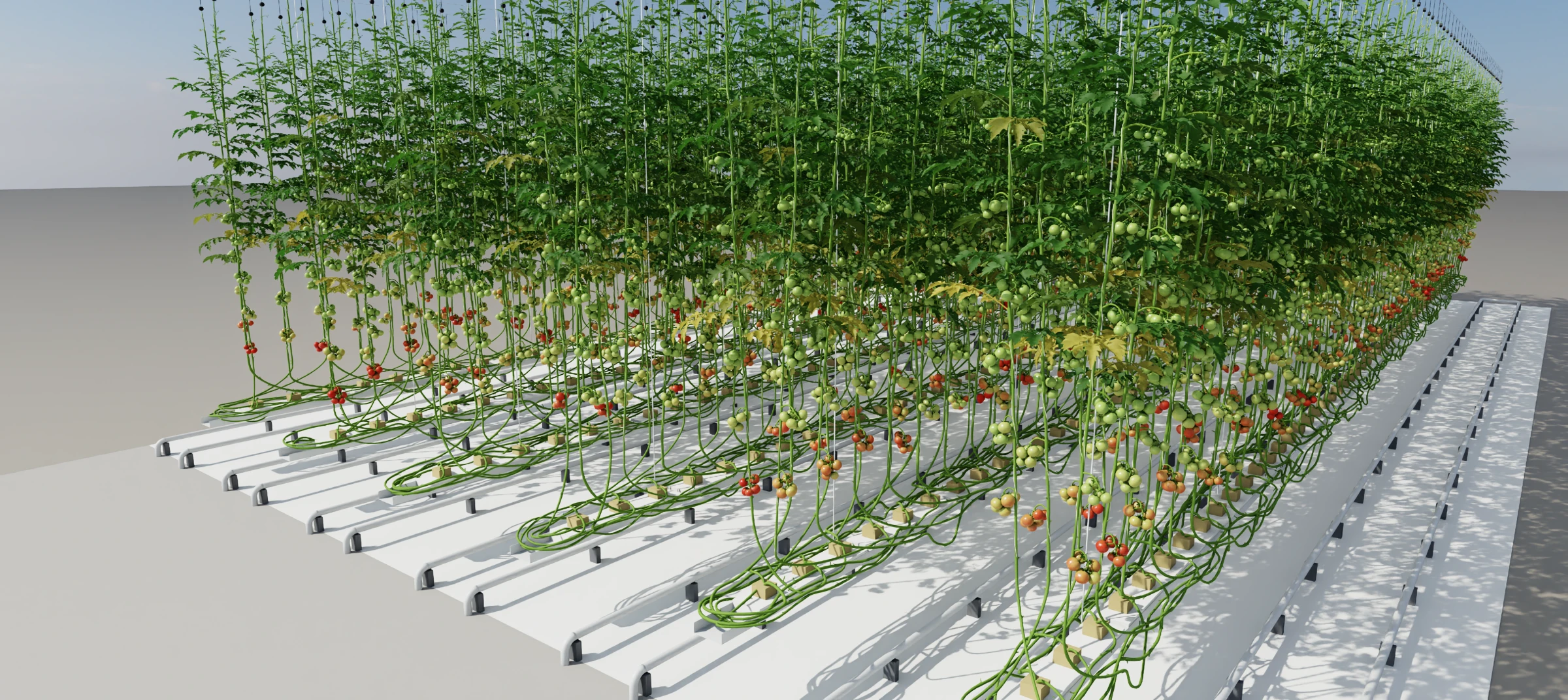 The default greenhouse in Isaac Lab, from its example
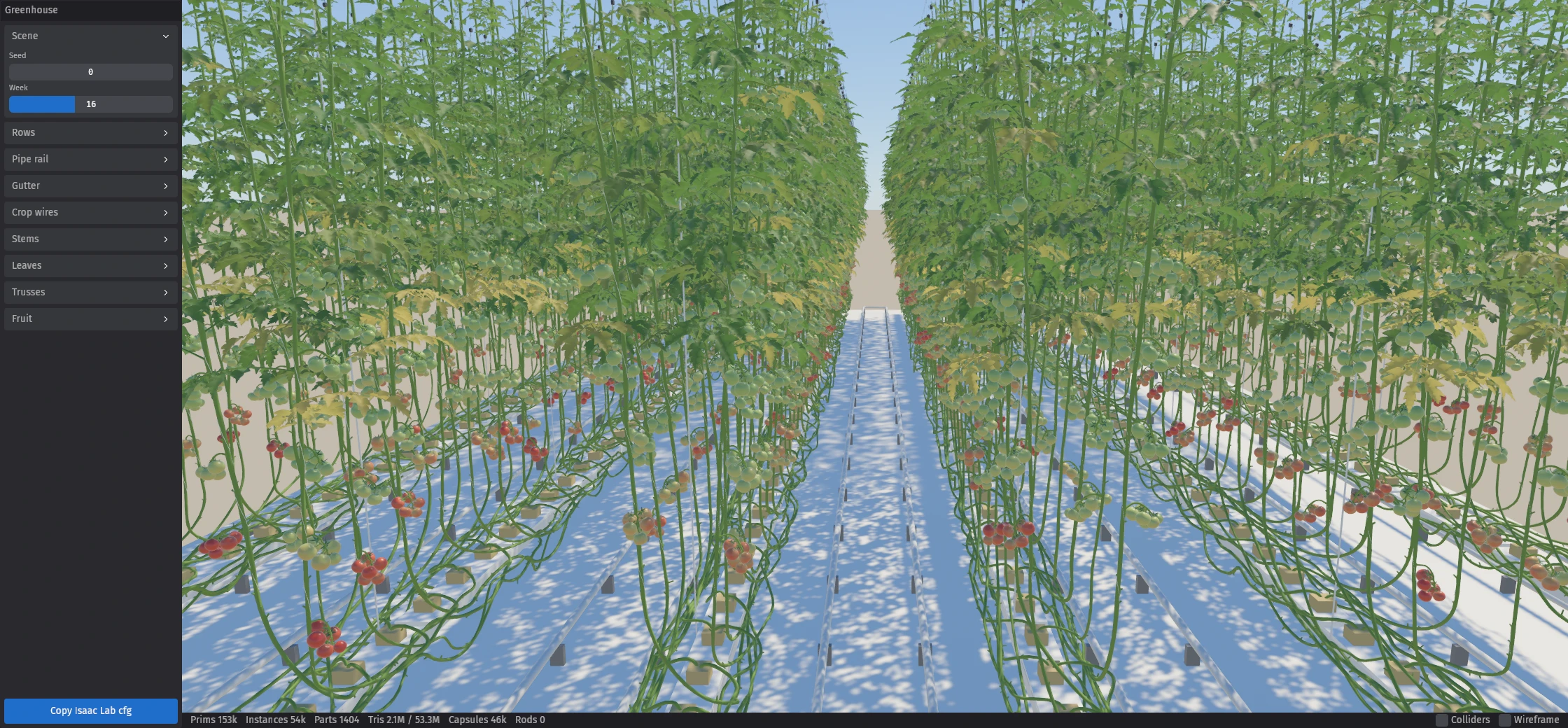 The viewer and its parameter panel, down a path between two rows
🌐 Try the parameter editor in your browser: azazdeaz.github.io/misina-lab/playground/greenhouse, a bit slower, and it needs WebGPU.
Contents: What a row holds · The crop's age · Running it · Prims
The dimensions and the variations are drawn from Dutch research compartments, supplier sheets and one measured truss study. A stem is deleafed as growers do it each week, stripped up to a truss, and carries the leaves it has grown since the last pass.
What a row holds
| Part | What it is | Knobs |
|---|---|---|
| Floor | white film under the crop and past the row ends, and concrete across the row heads, each its own collider | the main path's width |
| Rail | two heating pipes in every path, one loop: on a support every meter, each turned down into the floor through an elbow at the row head, to the mains under the main path, and the pair joined at the far end by two more elbows and a pipe across; each segment a capsule collider, and a chain of them round every bend | gauge, pipe diameter, height, unevenness up to and past the 2° spec |
| Gutter | a steel channel, hanging or standing, with stone wool slabs and a block at every plant | height, mount, plant spacing |
| Wires | two crop wires over every gutter, for the V the stems are trained in | height, spread |
| Stems | two to a plant, each grown up its twine to a hook on its wire and lowered along the gutter from then on, each a little ahead of or behind the crop, so no two hang their trusses level, the lowered runs drifting, crossing and sagging in a loose bundle, each stem climbing out of it along the row; kinked at every truss and a little at every node, thinner toward its head and to a point at its tip, and undulating along it; a leaf at every node and a truss in every third internode, the stem swelling at each and toward its stalk, the leaves stripped up to a truss and the trusses picked, each leaving a stub or a scar; colliding as a chain of capsules along the axis from where it leaves the bundle | the crop's age, harvest height, trusses on a stem, how far stems drift out of step, the truss stripped up to, days since deleafing, extra stems, trusses turned to the path, head thickness, mesh detail |
| Leaves | a compound leaf: a petiole flaring out of the stem and a rachis with a terminal leaflet, three or four pairs of laterals and small leaflets between them, each leaflet outlined from its veins and bent along them, folded up on its midrib, puckered between its veins, ruffled at its margin and twisting toward its tip where it is lopsided; small and upright at the head, its leaflets cut narrow, folded shut from the bud and held up along the rachis, full grown and drooping further down; a lighter green at the head, the oldest leaves fading toward yellow. Visual only, with no collider | length, droop, lobing, curl, fold, asymmetry, yellowing, variations, mesh detail |
| Trusses | the peduncle flaring out of the stem and bending round into a rachis that zigzags from fruit to fruit, swelling and kinking away from each pedicel and ending in its last fruit, its last internode that fruit's pedicel; standing out from the stem in flower and sagging under its fruit's weight as they swell, until it hangs from its bend, nearer vertical toward its tip; its stalks growing with its flowers, short in flower with its buds crowded at its tip, the rachis lengthening and the pedicels growing to about three times their length in flower before the fruit is full size; a pedicel flaring out of its underside to every other fruit, down one flank and then the other, bent down at its knuckle and on into the fruit's calyx; the fruit packed into a bunch, none in another, in a stem or run through by a pedicel, each pedicel swinging and bending at its knuckle to let its fruit by and each fruit's top toward its knuckle, the last pushed out past the rachis's end and facing back along it; a Cut and a Bend frame; below a height, a rod a solver bends and a robot cuts, carrying its fruit |
fruit count and diameter, branched, peduncle length, diameter and angle, stiffness, rachis internode, pedicel length and angle, jointed pedicels, stalks in flower, missing fruit; the height trusses bend below, on the stems |
| Fruit | every fruit its own prim with a collider round it; a lobe per locule, each its own width and fullness, a groove over each wall between two, deepest round the shoulders and fading toward the blossom end, and a lean of its own; an outline rounded either side of where it is widest, blocky or round at either end, its stem scar sunk in a dip and its blossom end pointed, flat or dented; a calyx of five or six narrow sepals spreading off its shoulders round its pedicel's end; and a stage from bud to red: the youngest trusses are buds at the head and open their flowers from base to tip below it, their petals swept back round the anther cone, fruit grow below them, a stem ripens from the bottom up, a truss from its base to its tip, and a fruit from its blossom end up and in patches, losing its green before it builds its red | ripe trusses on a stem, the spread in a truss, the ripe colour, how far the shoulders lag the blossom end, height to width, where it is widest, the stem dip, how blocky either end is, a pointed or dented blossom end, locules, ribbing and how far down it reaches, irregularity, petal length and reflex |
Rows run along +X from the row head at x = 0, the main path lies at negative x, and z = 0 is the top of the floor. Every gutter has a path on both sides, so every crop wall faces one a robot can drive.
The defaults grow a round truss tomato. These settings grow the other common types, as estimates:
| Setting | Cherry | Plum | Beefsteak |
|---|---|---|---|
truss.fruits |
15 | 6 | 4 |
truss.fruit_diameter |
0.025 | 0.05 | 0.08 |
truss.branched |
True |
False |
False |
fruit.aspect |
0.95 | 1.5 | 0.65 |
fruit.widest |
0.5 | 0.55 | 0.48 |
fruit.stem_dip |
0.04 | 0.04 | 0.22 |
fruit.stem_blockiness |
0.05 | 0.6 | 0.5 |
fruit.blossom_blockiness |
0.05 | 0.3 | 0.4 |
fruit.blossom_tip |
0 | 0.1 | -0.1 |
fruit.locules |
2 | 2 | 8 |
fruit.ribbing |
0.015 | 0.02 | 0.2 |
fruit.rib_reach |
0.3 | 0.2 | 0.5 |
fruit.irregularity |
0.5 | 0.7 | 1.5 |
The crop's age
The crop is grown to an age, scene.week, the weeks since planting:
flowchart LR
    planted["Week 0<br/>a 0.4 m transplant"] --> young["Young crop<br/>on its twines below the wires,<br/>green fruit only"]
    young --> wires["About week 9<br/>heads reach the wires,<br/>first trusses ripen"]
    wires --> lowered["From then on<br/>stems lowered along the gutter,<br/>a truss's worth a week"]
A stem grows about a truss a week, so a crop deep into the season has meters of bare stem lying along the gutter beside it.
Running it
From the repository root,
cargo run --release -p greenhouse-lab
opens the viewer and its parameter panel. From Python, after
pip install greenhouse-lab:
import greenhouse_lab

params = greenhouse_lab.GreenhouseParams()
params.rail.unevenness = 1.0
params.write_usd("greenhouse.usda")
In Isaac Lab, greenhouse_lab.isaaclab.GreenhouseCfg spawns the scene as
an asset; examples/greenhouse_demo
is the smallest script that does. docs/parameters.md
lists every parameter, with its default and range.
Prims
/Greenhouse
  /Floor/Film  /Floor/Concrete        each its own collider
  /Paths/Path_03/Rail
    /Pipe_L_007/Steel  /Collision     one segment, support to support
    /Support_L_007 …
    /Elbow_L                          down into the floor at the row head
      /Steel  /Collision_00 …
    /ReturnBend                       the pair joined at the far end
      /Steel  /Collision_00 …
  /Rows/Row_02
    /Gutter  /Hanger_00 …  /Slab_00 …  /Block_017 …
    /Wire_L  /Wire_R
    /Plant_017
      /Stem_0
        /Tube  /Hook  /Twine
        /Collision_00 …               a capsule along each straight span of the stem, root up
        /Leaf_00 …                    the lowest still on the stem first
        /Truss_00                     the lowest still on the stem
          /Peduncle  /Cut  /Bend
          /Fruit_00/Skin  /Collision  a sphere round the body, a capsule on an elongated one
          /Fruit_01 …
Cut sits at the peduncle's base and Bend halfway round its bend, each with
+X along the peduncle: where a cut-flush gripper and a clamp-and-cut one
take a truss. Every fruit carries greenhouse_lab:stage, bud or
flower before it sets, then its growth stage or USDA colour class, and
greenhouse_lab:ripeness, the share of its surface that its USDA class
counts as coloured, read off its stage.
A truss whose node is below StemCfg.flexible_below is a rod instead, its
peduncle and rachis a Cable and a prim per segment that Newton drives:
        /Truss_00
          /Cable                      the curve the solver bends, never drawn
          /Cable_edge_body_0 …        a segment, its tube as /Stem
            /Pedicels  /Fruit_00 …    whatever leaves the rachis on it
            /Bend                     on the segment at the bend's middle
          /Cut
With StemCfg.skinned, the rod is drawn by one skin that bends with it
instead of a tube on each segment, which kinks at every joint: /Skin, a
SkelRoot beside the segments, and the segments carry no /Stem.
The fruit weigh on the rod, and Cut sits within a centimetre of its first
joint, so Shears cutting there drops the whole truss. A fruit's collider
rides its segment's body too, seated there by the rod tuning, and passes
through its own truss.
Left is +Y: the side on the left looking down a row from its head. A
standing gutter has Stand_00 … where a hanging one has hangers.